Your three-year-old is melting into the kitchen floor because the banana broke in half. Your six-year-old slams a door over a board game. In these moments it can feel like the goal is to stop the storm — but the more useful, longer-game work is teaching kids to name their feelings. When a child can say "I'm frustrated" instead of throwing the controller, they've gained a tool they'll use for the rest of their life. This guide walks through what's actually happening in a young brain during a big feeling, and gives you concrete, age-aware ways to build that emotional vocabulary at home.
Why naming feelings matters more than calming them
There's a well-loved phrase among child psychologists: "name it to tame it." When a child puts a word to what they're feeling, it engages the thinking part of the brain and takes some of the heat out of the emotional part. The label itself is regulating.
This is why your first job isn't to fix the feeling or end it quickly — it's to help your child notice and name it. A kid who learns "this big squeezy feeling in my chest is anger" is building a map. Over time that map lets them pause, recognize what's happening, and choose what to do next instead of being swept along by it.
“Children can't manage an emotion they can't recognize. Vocabulary is the first tool we hand them.”
— A common refrain in early-childhood education
Start with the core four (then build outward)
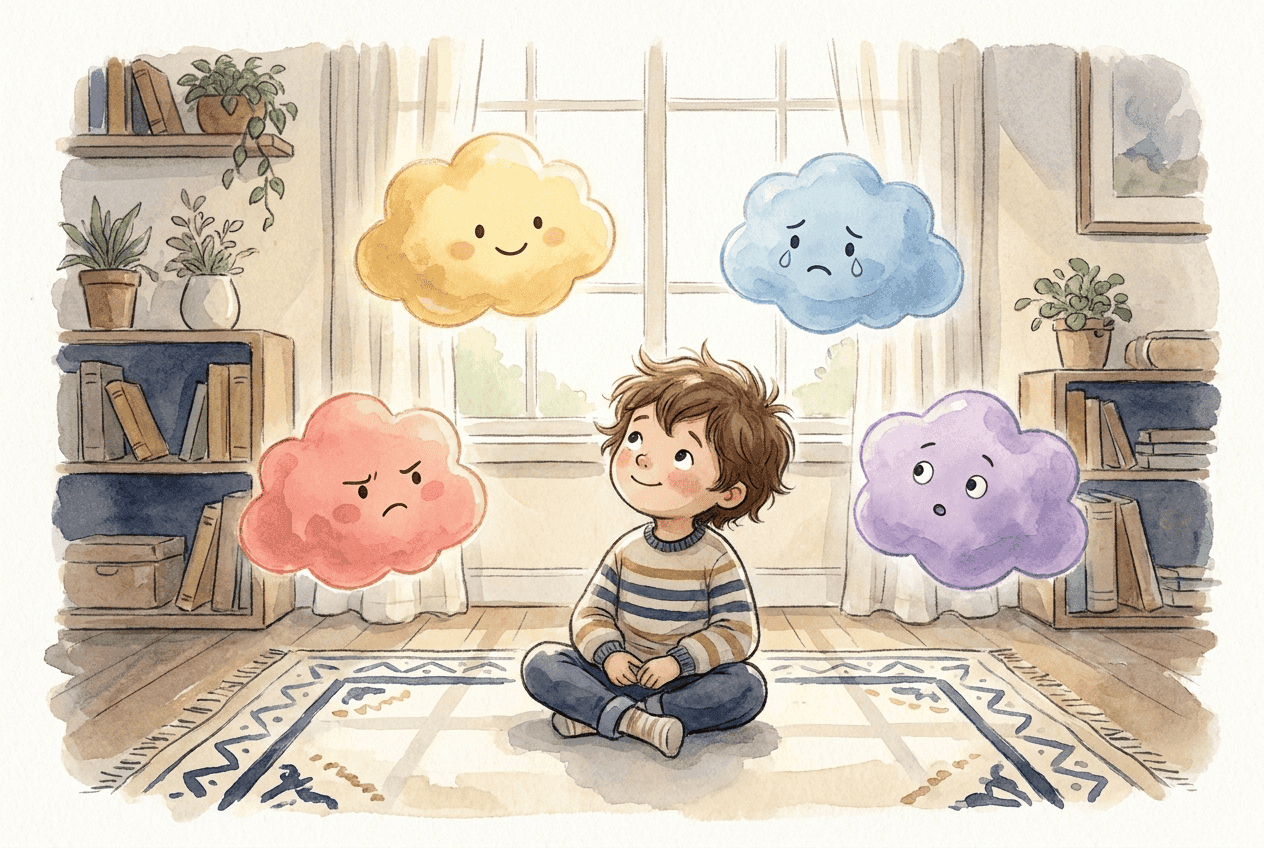
You don't need a 40-word feelings chart for a toddler. Start small and concrete. Most kids can anchor to four basic emotions before they're ready for nuance:
- Happy — for the bright, light, want-to-bounce feeling
- Sad — for the heavy, droopy, want-to-cry feeling
- Mad — for the hot, tight, want-to-stomp feeling
- Scared — for the shaky, fast-heart, want-to-hide feeling
Once those are solid, expand into the shades: frustrated, disappointed, nervous, embarrassed, jealous, excited, proud. Pair each new word with a body sensation, because young kids feel emotions physically long before they can name them. "Your fists are tight and your face is hot — that looks like frustrated."
What to say in the moment: simple scripts that work
In the heat of a meltdown, less is more. Long explanations don't land on a flooded brain. These short scripts give you something to reach for when your own patience is thin:
- Narrate, don't quiz: "You really wanted that cookie. You're disappointed." (Better than "Why are you crying?")
- Validate before redirecting: "It's okay to be mad. It's not okay to hit. Let's stomp our feet instead."
- Offer two words and let them pick: "Are you feeling worried or angry?" Choice gives them ownership.
- Name your own feelings out loud: "I'm feeling frustrated that we're late, so I'm taking three deep breaths."
A child in a true emotional flood can't access reasoning or learn a lesson. Lower your voice, get to their eye level, and connect first. The teaching happens later, once the wave has passed and they feel safe.
An age-by-age guide
What's developmentally fair to expect changes fast in the early years. Calibrate your expectations to where your child actually is:
- Ages 1–2: Mostly body-based. You do the naming for them. Mirror their face and supply the word: "Sad. You're sad the bubbles popped."
- Ages 3–4: Starting to use feeling words but easily flooded. Big tantrums are normal. Practice the core four during calm moments, not just during storms.
- Ages 5–6: Can name more nuanced feelings and understand that two things can be true at once ("excited and nervous about the first day"). Great age for stories and role-play.
- Ages 7–9: Capable of reflecting after the fact. Ask "What was happening in your body right before you got mad?" to build self-awareness and early coping strategies.
Build the skill when everyone is calm
The biggest mistake parents make is only talking about feelings during a crisis. Emotional vocabulary is like any skill — it's learned through low-stakes practice, not high-stakes tests. Weave it into ordinary, peaceful moments so the words are already familiar when a hard feeling hits.
- Read stories and pause to ask, "How do you think she feels right now?"
- Play "feelings charades" — act out mad, proud, surprised and guess together.
- Use a daily check-in: "What was a happy moment and a hard moment today?"
- Keep a simple feelings chart on the fridge they can point to when words are hard to find.
- Label feelings in characters during shows and movies as a no-pressure way in.
Use stories to make feelings safe to explore
Stories let children rehearse emotions from a safe distance. A character who feels scared of the dark, then finds courage, gives your child both the vocabulary and a model — without the pressure of it being about them in the moment. This is why books are one of the gentlest ways to teach emotional literacy.
It's even more powerful when the child sees themselves in the story. When your own child is the hero who feels nervous before the first day and works through it, the lesson sticks in a way a generic character can't match. A few of our courage stories and our bedtime calm titles are built around exactly this — naming a big feeling, then moving through it. You can browse sample books to see how a story can put words to what your child is carrying.
When to seek extra support
Big feelings are normal and healthy. But reach out to your pediatrician or a child therapist if emotional outbursts are intense, frequent, and not easing with age; if your child seems persistently sad or anxious; or if feelings are regularly interfering with sleep, friendships, or school. Asking for help early is a strength, not a failure.
Key takeaways
- Naming an emotion is itself calming — "name it to tame it" engages the thinking brain.
- Start with four core feelings (happy, sad, mad, scared) and pair each with a body sensation before adding nuance.
- Connect and validate before you correct or teach; a flooded child can't learn a lesson.
- Practice feelings vocabulary during calm, everyday moments — not only during meltdowns.
- Stories where your child is the hero make big emotions safe to explore and easier to name.
Frequently asked questions
At what age can a child name their own feelings?+
Most children begin using basic feeling words like happy, sad, and mad around ages 2 to 3, but they need adults to model and label emotions long before that. By ages 5 to 6, many kids can name more nuanced feelings and understand that two emotions can happen at once. Progress varies widely, so meet your child where they are rather than to a fixed timeline.
How do I teach my toddler to name feelings during a tantrum?+
In the moment, keep it short and connect first. Get to eye level, lower your voice, and narrate what you see: "You're so mad the toy broke." Don't quiz or explain — a flooded toddler can't process much. Save the real teaching for calm moments later, when you can practice feeling words through books, play, and daily check-ins.
What are some good ways to build a child's feelings vocabulary?+
Read stories and ask how characters feel, play feelings charades, do a daily high-and-low check-in, keep a feelings chart they can point to, and name your own emotions out loud. Personalized stories where your child is the hero are especially effective because they pair the vocabulary with a relatable model of working through a big feeling.
Written by The Hello Storybook Team, Parents, writers & storytellers.
← All stories