If you've found yourself quietly counting how many words your toddler actually says — and comparing them to the chatty kid at playgroup — you are far from alone. "My toddler isn't talking, when should I worry?" is one of the most common questions parents whisper to each other and type into Google at 11pm. The honest answer is that children vary enormously, and most late talkers catch up beautifully. But there are also clear milestones and genuine red flags worth knowing, so you can act early if you need to. Here's a calm, practical guide to what's typical, what's not, and what you can do at home today.
What "normal" actually looks like (and why it's a wide range)
Language development follows a general pattern, but the timeline has a lot of give. Some children say their first word at 10 months; others barely speak at 18 months and are suddenly stringing sentences together by their second birthday. Both can be perfectly typical. What matters more than hitting a single milestone on time is steady forward movement — new sounds, new words, new ways of communicating adding up over the months.
It also helps to know that comprehension comes before speech. A toddler who follows instructions, points to things you name, and clearly understands you is doing a huge amount of language work, even if the talking lags behind.
Toddler speech milestones by age
Use these as a gentle map, not a pass-fail test. Milestones describe what most children do by a certain age, not a deadline every child must meet.
- By 12 months: babbles with varied sounds, uses gestures like pointing and waving, responds to their name, and may have one or two words like "mama" or "dada."
- By 18 months: says around 10–20 words, points to show you things, follows simple one-step instructions, and tries to copy words you say.
- By 2 years: uses at least 50 words, starts combining two words ("more milk," "daddy go"), and is understood by familiar adults about half the time.
- By 3 years: has a few hundred words, speaks in short sentences, asks questions, and is mostly understood by people outside the family.
Many speech-language specialists flag the "50 words and two-word combinations by age 2" marker as a useful checkpoint. A child who is well behind on both is worth a closer look — not a cause for panic, but a good reason to get an assessment.
Toddler not talking: when to worry
Most of the time, a quiet toddler is just a late talker who will catch up. But certain signs are worth taking seriously, because early support works best. Talk to your pediatrician or ask for a speech-language assessment if you notice any of these:
- No babbling or gesturing (pointing, waving, reaching) by 12 months.
- No single words by 16–18 months.
- No two-word phrases by age 2.
- Losing words or skills they previously had, at any age.
- Not responding to their name or seeming not to hear you consistently.
- Little interest in connecting — rarely making eye contact, sharing attention, or showing you things.
- Speech that's so unclear that even you struggle to understand them by age 3.
That last cluster — loss of skills, limited social connection, not responding to name — matters most, because language delay combined with social or sensory differences is something you want evaluated sooner rather than later. Trust your gut. You are not "overreacting" by asking; a good professional will take your concerns seriously and reassure you if all is well.
Late talker or language delay? The difference
These terms get used interchangeably, but they point to different things. A "late talker" is typically a child between 18 and 30 months who understands language well and is developing normally in every other way — they just aren't talking much yet. Most of these children catch up on their own or with a little support.
A "language delay" or "disorder" is when the gap is wider, persists, or sits alongside difficulties with understanding, play, or social connection. Only an evaluation can tell them apart — and that's exactly why early assessment is helpful rather than alarming. There's no downside to checking, and early intervention services are often free or low-cost through local programs.
“The best thing we did was stop waiting to see. The assessment was gentle, and either way we'd have walked out knowing more than we did before.”
— Parent of a late-talking two-year-old
How to grow your toddler's language at home
Whether your child is a late talker or just gathering steam, everyday interaction is the single most powerful tool you have. You don't need flashcards or apps — you need responsive, back-and-forth connection. Here's what actually moves the needle:
- Narrate your day. Describe what you're doing in simple language: "Pouring the water. Warm water. Splash!"
- Follow their lead. Name whatever they're already looking at or playing with, rather than redirecting them.
- Pause and wait. After you ask something, count to five in your head. Toddlers need processing time, and the silence invites them to fill it.
- Expand what they say. If they say "dog," you say "big dog!" or "the dog is running." You're modeling the next step up.
- Reduce screens and background noise. Language grows in real conversation, not passive watching.
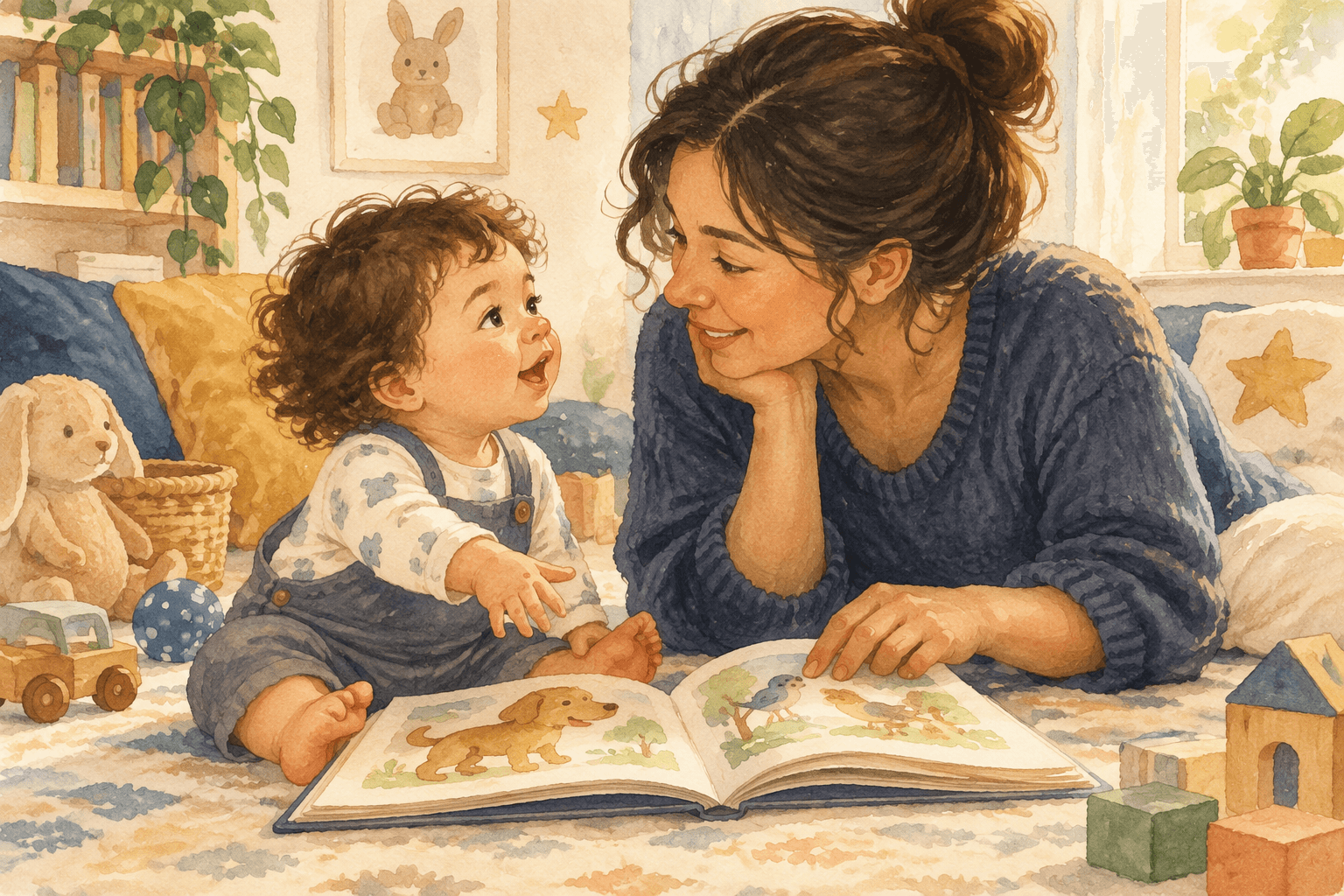
- Read together every day — slowly, with pointing, questions, and plenty of room for them to chime in.
Reading aloud deserves special mention because it packs vocabulary, attention, and connection into a few cozy minutes. Our read-aloud tips for turning story time into a ritual can help you get more conversation out of each book, and if you're not sure what suits this age, our guide to the best books by age is a good place to start.
Why hearing their own name in a story helps
Toddlers learn language fastest when it's about them and the people and things they love. Research on early vocabulary consistently shows that children pick up words tied to personal meaning — their name, their caregivers, their favorite objects — long before abstract ones. That's one reason personalized stories can be such a gentle language boost: when your child is the hero on every page, they lean in, point, and try the words that matter most to them.
A personalized bedtime story where your toddler sees themselves doing familiar things gives you endless natural prompts: "Who's that? That's YOU! What are you doing? Jumping!" If you'd like to make one, create a book starring your child and use it as a daily, no-pressure conversation starter. It won't replace professional support where that's needed — but as a tool for connection and repetition, few things beat a story your toddler recognizes as their own.
What to do next, step by step
- Track it for a few weeks. Jot down words, gestures, and new sounds so you can see the trajectory rather than a single snapshot.
- Talk to your pediatrician at the next visit — or sooner if you see red flags. Bring your notes.
- Ask about a speech-language evaluation and local early intervention services; you usually don't need a referral to request one.
- Keep the home strategies going regardless. They help every child, late talker or not.
- Breathe. Early action is a sign of a tuned-in parent, not a sign that something is wrong.
If your quiet toddler is also navigating big changes — starting daycare, a new sibling, or separation worries — stress can temporarily dampen talking, and that's worth keeping in mind. Our piece on starting daycare drop-off touches on how transitions affect little ones.
Key takeaways
- Most late talkers catch up; steady progress matters more than hitting any single milestone exactly on time.
- Worth an evaluation: no words by 18 months, no two-word phrases by age 2, loss of skills, or limited social connection at any age.
- Everyday responsive talk — narrating, pausing, following their lead, and reading together — is your most powerful tool.
- Early assessment has no downside: it either reassures you or gets your child support when it works best.
Frequently asked questions
At what age should I worry if my toddler isn't talking?+
Consider an evaluation if your child has no single words by 16–18 months, isn't combining two words by age 2, loses words they once had, or doesn't respond to their name or connect socially. Steady progress is reassuring; a stall or regression is worth checking with your pediatrician.
Can a late-talking toddler still be completely normal?+
Yes. Many late talkers understand language well, communicate with gestures, and simply start speaking later, then catch up fully — often around age 2 to 3. The key signs that it's likely typical are good comprehension, social connection, and new skills still emerging over time.
How can I help my toddler talk more at home?+
Narrate your daily activities in simple words, follow your child's lead, pause to give them time to respond, expand on what they say, limit screen time, and read together every day. Personalized, familiar stories are especially motivating because toddlers engage most with words about themselves.
Written by The Hello Storybook Team, Parents, writers & storytellers.
← All stories